Your battery is dead and your car won’t start. The fastest solution is a professional jump-start delivered to your location. Tow Jet Towing dispatches 24 hours a day with commercial-grade lithium jump-start equipment — safe for push-button start systems, hybrid vehicles, and any modern car with advanced onboard electronics.
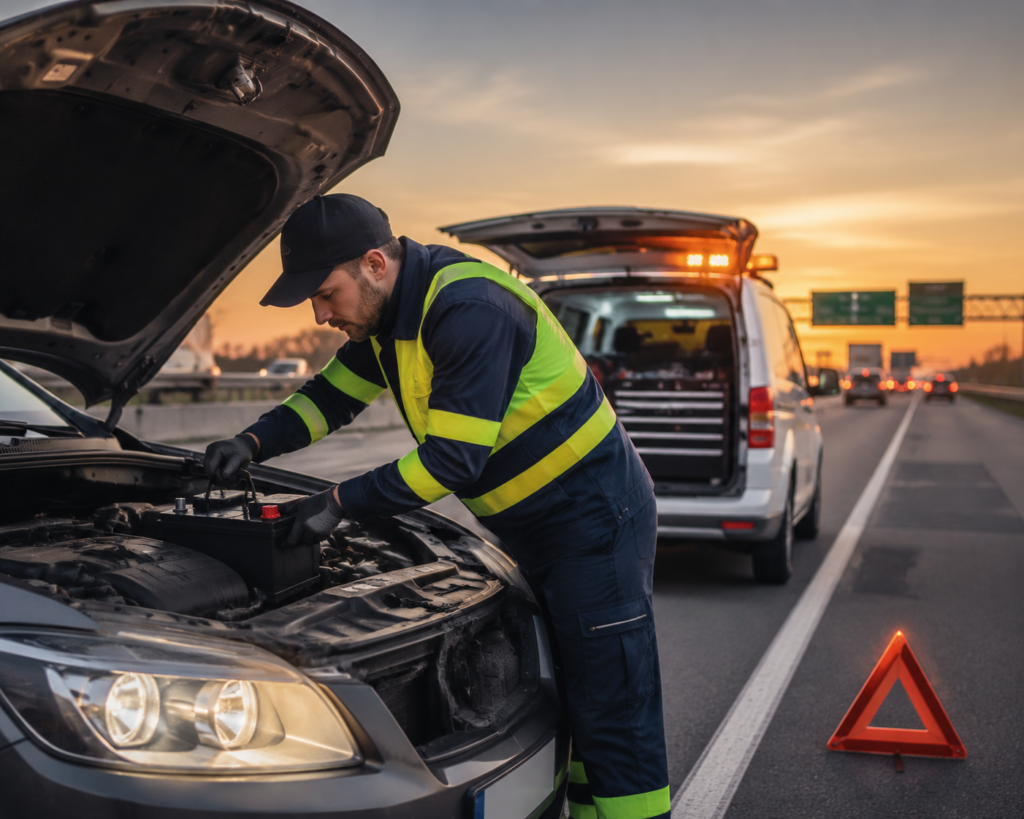
Fast battery boost services for dead batteries caused by cold weather, leaving lights on, aging batteries, or unexpected roadside breakdowns.
Interior lights left on overnight — dead by morning in a Newton or Guildford driveway
Battery failure in an underground Surrey Central or King’s Cross parkade
Cold January morning kill — battery that held all summer gives out below -5°C on 152nd Street
Sitting vehicles — car parked 3+ weeks at YVR or a long trip, battery fully discharged
Repeated failure — battery that starts then dies again within minutes (alternator or parasitic drain issue)
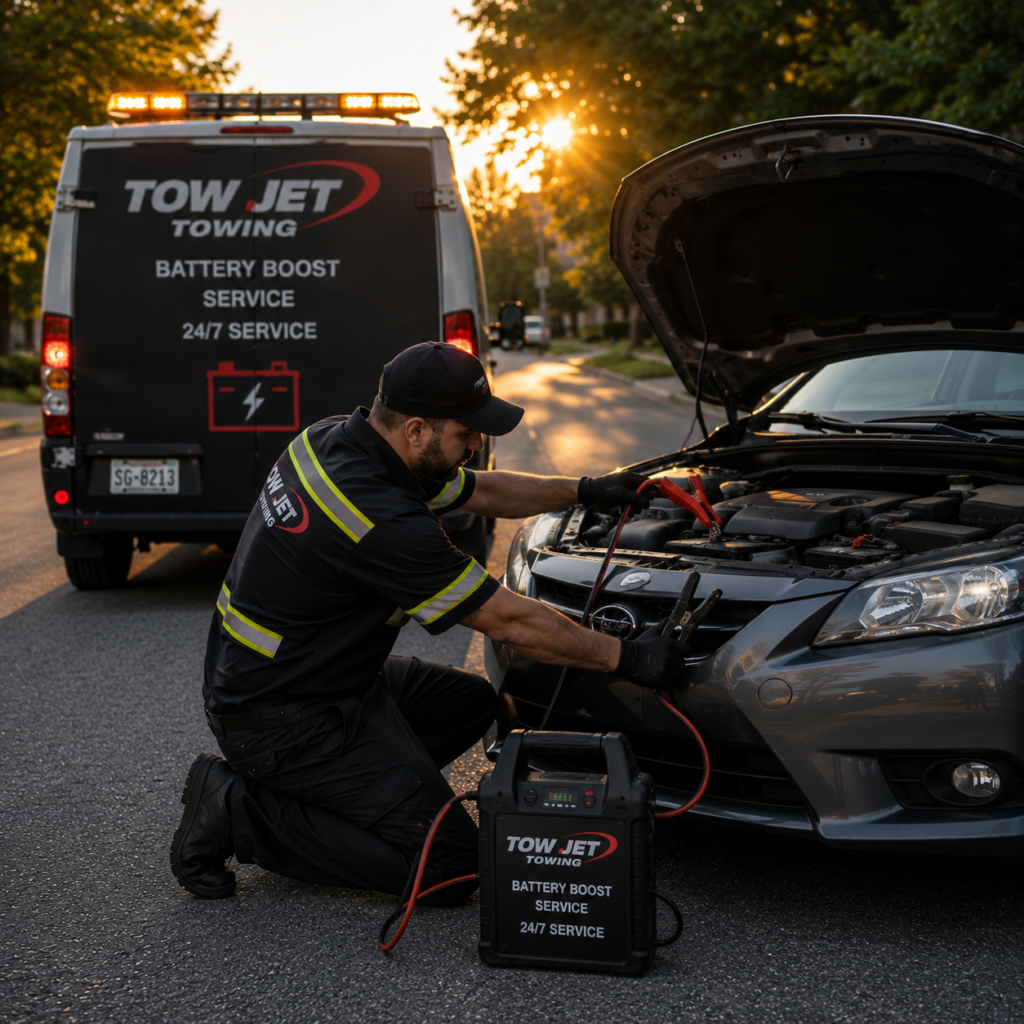
Not all jump-starts are the same. Consumer jumper cables connected car-to-car — or cheap portable packs from a hardware store — deliver an unregulated charge. On older vehicles this is usually fine. On modern vehicles, it can cause issues.
Modern vehicles — especially those with push-to-start, start-stop systems, ADAS electronics, and multiple onboard ECUs — are sensitive to voltage spikes. Our commercial lithium jump-start packs deliver a controlled, regulated output that’s safe for all of these systems. It’s the same equipment used by professional mechanics and fleet roadside services.
With our commercial equipment, yes. The regulated output from our lithium packs is safe for vehicles with keyless entry, push-to-start systems, and multiple ECUs. Consumer cables and cheap portable packs carry more risk because of unregulated current.
Repeated battery failure after a boost usually points to one of three issues: a battery that can no longer hold a charge (age and cold weather are the most common culprits in Metro Vancouver), a failing alternator, or a parasitic electrical drain. We’ll tell you what we observe when we’re on site, and can tow you to a shop for diagnosis.
Hybrids have a standard 12V accessory battery (separate from the high-voltage traction battery) that can die and be boosted normally. The high-voltage traction battery is a separate system. If your hybrid won’t start, the 12V accessory battery is almost always the issue and a standard boost will get it going.
Electric vehicles don’t have a 12V starter battery in the traditional sense — they have a 12V auxiliary battery that powers accessories. If your EV won’t respond to the key fob or won’t power on, this auxiliary battery may be the issue. Call us and we’ll walk through the symptoms.
Tell us the parkade address and level when you call. We carry portable lithium packs that don’t require a second vehicle — we can access any parkade level that our truck can reach. For very low-clearance parkades, the technician can carry the pack in on foot.
The actual jump-start process takes 2–5 minutes once we’re on site. Most vehicles start within the first 60 seconds of connection.
Yes — drive for at least 20–30 minutes at highway speed to allow the alternator to recharge the battery. Avoid repeated short trips immediately after a boost, as the battery may not have enough time to recover.
Significantly. At -10°C, a battery loses approximately 50% of its cranking power compared to room temperature. Surrey winters aren’t extreme by Canadian standards, but nights below -5°C — especially in January and February — will expose any weak battery. If your battery is 3+ years old, get it tested before winter.
We’re based in Surrey and dispatch across 12 cities in Metro Vancouver and the Fraser Valley:
(604) 217-8300 — GPS dispatch, WreckMaster-certified operators, 24/7 across Metro Vancouver
Tow Jet Towing © 2026 | All Rights Reserved.